
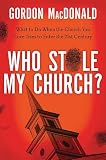
 Who Stole My Church? What to Do When the Church You Love Tries to Enter the 21st Century
by Gordon MacDonald
2007 Thomas Nelson Publishers
Gordon MacDonald artistically paints a picture of the turmoil many feel as our churches “try to enter the 21st century” in his recent fiction (really, a fiction?) entitled Who Stole My Church? The book cover says it all, “This is a fictional story that reflects the all-too-real situation of many church communities today, where loyal and long-standing members can feel pushed aside by the new demands of evangelism in the twenty-first century.”
Here’s an excerpt from the introduction:
All of us who gathered in the Commons that evening shared a common history: We’d been raised by parents who had persevered through the Great Depression and fought (or supported the soldiers) in World War II. We could remember a time when most homes had only one telephone, if any, and when an extension phone (once a common term) was considered a luxury. We could recall summertime polio epidemics, radio dramas, and President Truman. We had grown up afraid of communists, curious about UFOs, and envious of anyone owning a 1949 Ford with twin Hollywood mufflers. Another thing we all had in common was that we were all church people, Christian in our life commitment. All of us had years and years of history invested in organized religious life. And more than a few in the group–I was an exception–had been a part of this particular church since infancy….We were descendants of a passing Christian culture. We could swap stories of memorable Billy Graham campaigns. We often reminisced about our Saturday night dates at Youth for Christ rallies. And we were quite familiar with traditional church functions: midweek prayer services, VBS, Watch Night services on New Year’s eve, and sunrise services on Easter morning to which we were dragged by parents whose lives were defined by the church calendar….We’d all been to summer camp, and we’d sung and even acted in Christmas cantatas.Our histories also included missionary festivals, prophecy conferences, and Bible exposition weekends. We were taught from our earliest days that the standard for biblical giving was the tithe: 10 percent of our earnings…. When the church opens its doors, we have always shown up…. That is, until lately. Now something may be changing in our generational ranks. Faithful people who always used to be as dependable as the ocean tides on the Maine coast are beginning to signal a bit of annoyance with their churches. And their gifts and their faithfulness in attendance are beginning to fray at the edges. (p. xiv-xvi)

Leave A Comment